Beauty and cosmetics is one of the highest-margin wholesale categories available to Australian retailers, with the domestic market valued at over $8 billion and growing year on year. Whether you are stocking a salon, launching an online beauty store, supplying pharmacies, or building your own private-label cosmetics brand, finding the right wholesale beauty suppliers is the single most important decision you will make.
This guide covers everything you need to know about sourcing wholesale cosmetics, skincare, makeup, haircare and salon supplies in Australia: the different supplier types available, pricing benchmarks across every subcategory, regulatory requirements you cannot afford to ignore, and where to find verified wholesale beauty suppliers in every state.
As the team behind Australian Wholesalers Directory, Australia's largest wholesale supplier directory operating since 2001, we have compiled this guide from years of experience connecting retailers with verified suppliers across every product category and state.
Quick link: Already know what you need? Browse all wholesale beauty and cosmetics suppliers on the directory, or narrow it down: hair care and styling, beauty dropshippers, or browse by location.Browse relevant suppliers: Health Products.
Why Wholesale Beauty Is a High-Growth Retail Category
 Beauty products sit in a unique position in the wholesale landscape. They combine repeat-purchase behaviour (customers reorder foundation, moisturiser and shampoo on a predictable cycle) with high perceived value and strong brand loyalty. Unlike most wholesale categories where price is the primary driver, beauty buyers make purchasing decisions based on ingredients, brand reputation, packaging and product experience, meaning retailers can command premium pricing without constant discounting.
Several structural trends are driving growth in the Australian beauty wholesale market. The shift toward clean beauty, natural ingredients and cruelty-free products has created new premium niches that did not exist five years ago. K-beauty (Korean skincare and cosmetics) has exploded in popularity, with dedicated Australian distributors now carrying dozens of Korean brands. The professional salon and clinic channel continues to grow as Australians spend more on facials, skin treatments and cosmetic procedures. And social media, particularly TikTok and Instagram, now drives product discovery faster than traditional retail ever could, creating sudden demand spikes that well-stocked retailers can capitalise on.
Types of Wholesale Beauty Suppliers in Australia
The beauty wholesale market includes several distinct supplier types. Understanding the difference helps you choose the right partners for your specific retail model.
| Supplier Type | Best For | Typical MOQ | Margins |
|---|---|---|---|
| Brand-authorised distributors | Salons, pharmacies, premium retail, online stores | $200-$1,000 first order | 30-50% off RRP |
| Discount/overstock wholesalers | Discount retailers, market stalls, online bargain stores | $100-$500 per order | 50-70% off RRP |
| Private-label manufacturers | Own-brand retailers, salons, clinics wanting branded products | 50-500 units per SKU | 60-80% gross margin |
| Raw ingredient suppliers | Formulators, DIY skincare makers, private-label brands | Varies widely (1kg to bulk) | Depends on formulation |
| K-beauty and niche distributors | Online stores, beauty subscription boxes, trend-focused retail | $500-$1,000 first order | 40-60% off RRP |
| Professional salon suppliers | Hair salons, beauty clinics, nail technicians, spas | No minimum to $150 for free shipping | 30-50% off RRP |
Pro tip: The highest margins in beauty wholesale come from private-label and own-brand products. If you have an established customer base, working with an Australian contract manufacturer to produce skincare or cosmetics under your own brand eliminates the brand markup entirely and gives you full control over pricing, ingredients and packaging.
Popular Wholesale Beauty Subcategories
Makeup and Colour Cosmetics
Colour cosmetics cover foundations, concealers, eyeshadows, lipsticks, mascaras, blushes and setting powders. This is the most brand-driven beauty subcategory, where consumers tend to be loyal to specific products and shades. For retailers, this creates reliable repeat-purchase patterns once you stock the right brands for your customer base.
The Australian makeup wholesale market splits into two tiers. Authorised distributors carry premium and mid-range brands (think L'Oreal, Maybelline, NYX, Revlon, Covergirl) at standard trade pricing, typically 30-40% below recommended retail. Discount and overstock wholesalers offer the same brands at deeper discounts (50-70% off RRP) but with less predictable stock availability, as they source from closeouts, overruns and short-dated inventory.
Mineral makeup is a growing sub-niche, with Australian manufacturers like Wholesale Mineral Makeup (WMM) offering both wholesale supply and private-label services. This is particularly attractive for retailers wanting to build their own clean beauty brand without the complexity of formulation from scratch.
Skincare
Skincare is the fastest-growing segment of the Australian beauty market and the one with the strongest long-term fundamentals. Consumers are spending more on serums, moisturisers, cleansers and treatments than ever before, driven by increased awareness of ingredients like hyaluronic acid, retinol, niacinamide and vitamin C. Unlike makeup, which can be trend-dependent, core skincare products generate extremely consistent repeat purchases.
Wholesale skincare pricing varies enormously depending on the tier. Professional clinic-grade products from brands distributed through authorised channels command 30-40% trade discounts. Natural and organic skincare from Australian manufacturers typically offers 50% wholesale margins. K-beauty skincare, which has surged in popularity, is available through specialist distributors at 40-60% below Australian retail pricing.
Korean Beauty (K-Beauty)
K-beauty deserves its own mention because it has reshaped the Australian beauty market over the past few years. Korean skincare and cosmetics brands like COSRX, Laneige, Innisfree, Biodance, and MEDI-PEEL are now mainstream in Australia, driven by TikTok virality and the Korean multi-step skincare routine trend.
Several Australian-based distributors now specialise exclusively in K-beauty wholesale, offering authorised distribution for dozens of Korean brands. Minimum orders typically start at $500-$1,000, with free Australia-wide shipping above certain thresholds. For online retailers, K-beauty is particularly lucrative because consumers actively search for specific product names and brands, driving high-intent organic traffic to your store.
Haircare and Styling Products
 Haircare is the workhorse of the professional beauty supply chain. Shampoos, conditioners, treatments, styling products and hair colour are consumed in large volumes by both salons and retail consumers. Professional salon brands (Redken, Joico, Schwarzkopf, Wella, Matrix) are distributed through authorised wholesale channels that typically require proof of a salon or retail business before granting trade accounts.
The haircare wholesale market also includes tools and electrical equipment: straighteners, curling wands, hair dryers and clippers from brands like GHD, BaByliss, Silver Bullet and Parlux. These carry higher price points but also generate strong margins, and many professional suppliers stock both product and equipment under one trade account. Browse hair care and styling suppliers on the directory.
Natural, Organic and Clean Beauty
Australia has a strong domestic manufacturing base for natural skincare and clean beauty products. Brands formulated and produced locally using native Australian ingredients (Kakadu plum, tea tree, macadamia, lemon myrtle) carry premium positioning both domestically and in export markets. For retailers, natural beauty offers the best of both worlds: higher retail prices driven by ingredient quality and sustainability credentials, combined with the "Australian Made" cachet that consumers are willing to pay more for.
Wholesale margins on Australian-made natural beauty products are typically 50-60%, with many manufacturers also offering private-label and contract manufacturing services for retailers wanting to develop their own natural beauty lines.
Professional Salon and Clinic Supplies
This segment covers the B2B supply chain for hair salons, beauty clinics, nail technicians, waxing specialists, lash and brow artists, and day spas. Products include professional-only formulations, salon furniture and equipment, disposables (gloves, bed rolls, wipes), waxing supplies, lash extensions, nail systems and tanning solutions.
Large Australian salon wholesalers like AMR Hair & Beauty and Le Beauty operate showrooms alongside online trade stores, offering thousands of SKUs across every salon category. Many operate with no minimum order, making them accessible to solo practitioners and small salons as well as large multi-location businesses.
Regulatory Compliance: What Retailers Must Know
Beauty and cosmetics regulation in Australia is more complex than most wholesale categories. Getting it wrong can result in product recalls, fines, and serious reputational damage.
Critical: All cosmetics and personal care products sold in Australia must comply with the Industrial Chemicals Act 2019 (administered by AICIS, the Australian Industrial Chemicals Introduction Scheme). This replaced the former NICNAS system. Additionally, sunscreens and products making therapeutic claims (such as anti-acne or anti-aging treatments) are regulated as therapeutic goods by the TGA (Therapeutic Goods Administration) and require separate registration or listing. Never assume a product is compliant just because it is sold overseas.
Key compliance areas for beauty retailers:
Ingredient disclosure. All cosmetic products sold in Australia must display a full ingredient list using INCI (International Nomenclature of Cosmetic Ingredients) naming conventions. This is a mandatory requirement under the Competition and Consumer Act.
AICIS chemical assessment. Every industrial chemical used in a cosmetic product must be listed on the Australian Inventory of Industrial Chemicals (AIIC) or introduced through the appropriate AICIS pathway. If you are importing products that contain novel ingredients not on the Australian inventory, you may need to apply for an assessment before the product can legally be sold.
Sunscreen and SPF claims. Any product marketed with SPF protection or sun-filtering claims is classified as a therapeutic good in Australia. It must be listed or registered with the TGA and carry an AUST L or AUST R number. Selling an unregistered sunscreen product in Australia is a serious offence.
Cruelty-free and vegan claims. Australia banned cosmetic animal testing in 2020 under the Industrial Chemicals (General) Rules. However, "cruelty-free" and "vegan" marketing claims are not regulated terms, so retailers should verify that suppliers hold recognised certifications (such as Choose Cruelty Free, Leaping Bunny, or PETA) rather than relying on self-declared claims.
Product labelling. Cosmetics must display the product name, net weight or volume, full ingredient list, manufacturer or importer details, country of origin, and any required warnings (such as allergen declarations for fragrances). Products that fail labelling requirements can be pulled from shelves by the ACCC.
For a broader overview of supplier verification and due diligence, see our guide to finding wholesale suppliers in Australia.
Wholesale Beauty Pricing: What to Expect
| Subcategory | Typical Wholesale Discount | Retail Margin Potential |
|---|---|---|
| Colour cosmetics (branded) | 30-40% off RRP (authorised) or 50-70% off (overstock) | 40-65% |
| Skincare (premium branded) | 30-40% off RRP | 40-50% |
| Skincare (natural/Australian-made) | 50-60% off RRP | 55-65% |
| K-beauty skincare and cosmetics | 40-60% off Australian retail | 50-65% |
| Professional haircare | 30-50% off RRP | 40-55% |
| Salon disposables and consumables | Trade pricing (volume-based) | 30-45% |
| Private-label skincare/cosmetics | Manufacturing cost only | 60-80% |
| Fragrances (branded) | 30-50% off RRP | 45-60% |
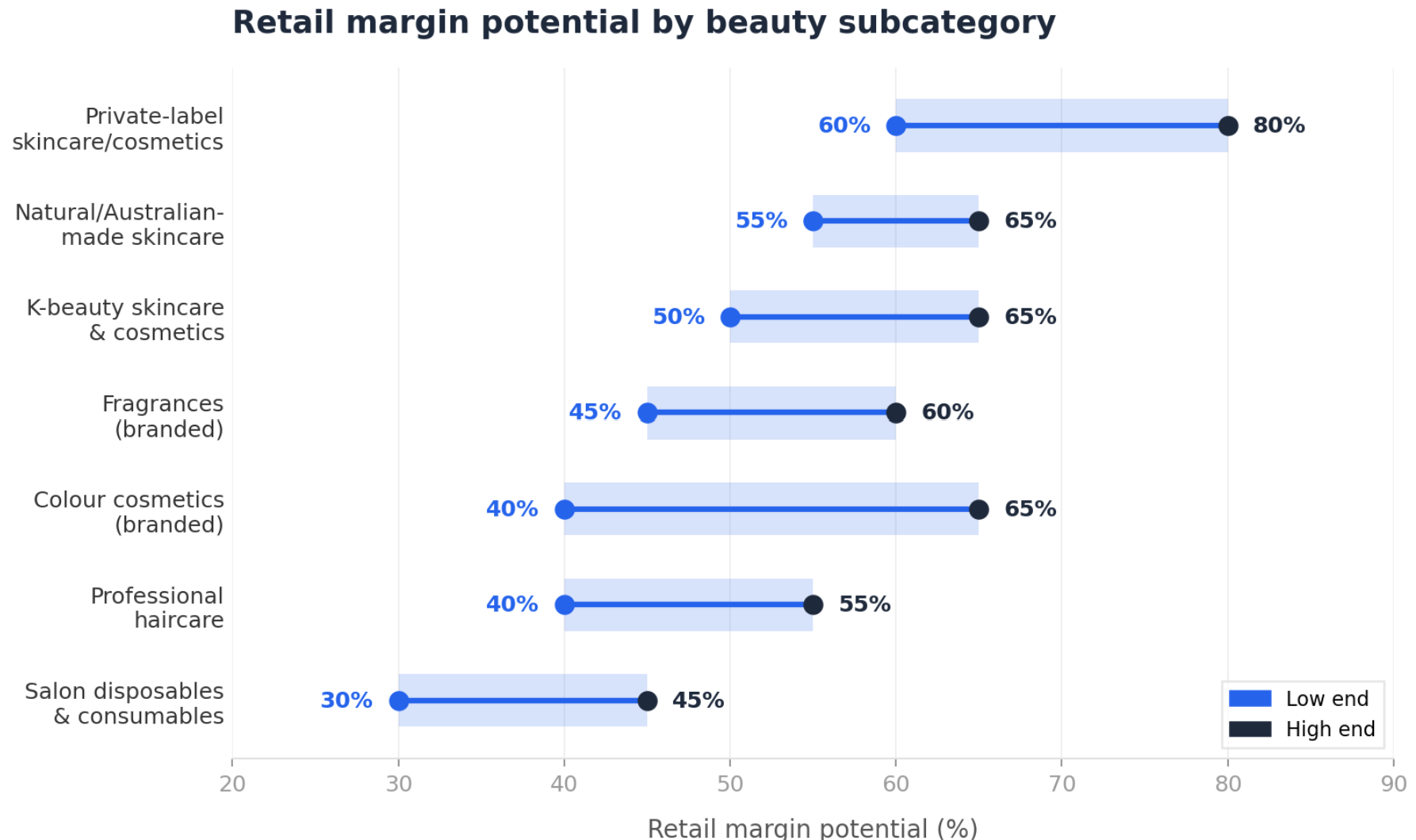
Pro tip: Margins in beauty are strongest on natural, Australian-made and private-label products because there is no international brand licensing premium built into the wholesale price. Branded cosmetics from major global labels offer lower margins but benefit from existing consumer demand and brand recognition, reducing your marketing costs.
Where to Find Wholesale Beauty Suppliers in Australia
Wholesale Directories
Australian Wholesalers Directory lists beauty and cosmetics suppliers across every state, searchable by product type and location. Browse supplier profiles, check product ranges and contact suppliers directly without middleman fees or commissions.
Australian Beauty Trade Shows
Beauty Expo Australia (held annually in Sydney) is the largest trade event for the professional beauty industry, covering skincare, cosmetics, salon equipment, nails, lashes, waxing and aesthetics. Hair Expo Australia is the dedicated event for the haircare and salon sector. The Reed Gift Fairs in Sydney and Melbourne also feature beauty exhibitors alongside giftware and homewares. Trade shows are invaluable for beauty sourcing because you can test textures, smell fragrances, assess packaging quality and negotiate trade terms face to face.
Key Wholesale Hubs
Sydney and Melbourne are the primary beauty wholesale hubs. Sydney's inner west (Marrickville, Alexandria, Waterloo) and northern suburbs (North Ryde, Epping) host several established cosmetics distributors and importers. Melbourne's south-east (Scoresby, Braeside, Dandenong South) and inner suburbs (Richmond, South Yarra) have strong concentrations of beauty wholesalers and salon suppliers with showroom facilities. Browse wholesale suppliers in Melbourne or Sydney.
Direct Import
Some Australian beauty retailers import directly from manufacturers in South Korea, China, Europe or the United States. Direct importing offers lower per-unit costs but carries significant compliance responsibilities. As the legal importer, you are personally liable for ensuring every product meets Australian AICIS requirements, correct labelling standards, and TGA registration for any products making therapeutic claims. Testing, certification and customs clearance costs must be factored into your margin calculations before committing to a direct import model.
Seasonal Buying Strategies for Beauty
While beauty products sell year-round, there are distinct seasonal patterns that savvy retailers plan around.
Christmas and gift-giving season (October to December). This is the biggest sales period for beauty, driven by gift sets, fragrances and skincare bundles. Order gift-packaged inventory by August to September. Many wholesale suppliers release limited-edition gift sets specifically for this period.
Mother's Day (May). The second-largest beauty gifting occasion in Australia. Skincare sets, fragrances and pamper packs perform exceptionally well. Order 8 to 10 weeks ahead.
Summer (November to February). Suncare, tanning products, body care and lightweight skincare see increased demand. This is also peak season for salon tanning supplies.
Winter (June to August). Richer moisturisers, face oils, lip treatments and hand creams sell well as consumers switch to more hydrating routines. Salon facial treatment bookings also tend to increase in cooler months.
Post-Christmas clearance. January is the best time to negotiate clearance pricing from suppliers looking to move excess seasonal stock, particularly on gift sets and limited-edition packaging. If you have storage capacity, buying seasonal overstock at deep discounts can deliver excellent margins when the next gifting season comes around. Consider listing your own excess beauty stock on our sell excess stock page to recover capital quickly.

Selling Wholesale Beauty Products: Channel Strategies
Online stores. Beauty is one of the strongest e-commerce categories in Australia. Niche positioning works best online, whether that is K-beauty, natural Australian skincare, professional salon products, or discounted branded cosmetics. SEO and social media are the primary traffic drivers. Strong product photography, ingredient lists and honest reviews are essential for conversion.
Physical retail. Beauty counters in pharmacies, gift shops, health food stores and dedicated beauty boutiques all perform well. In-store testers and the ability to swatch, smell and try products remain a major advantage that online cannot replicate.
Salon and clinic supply. Selling directly to hair salons, beauty clinics, nail technicians and day spas creates a reliable B2B revenue stream. Professional buyers reorder on predictable cycles and are less price-sensitive than retail consumers because they factor product costs into their service pricing.
Marketplace selling. Amazon, eBay, Catch and Kogan are significant channels for beauty products in Australia. Branded cosmetics and skincare perform particularly well on marketplaces because consumers search for specific product names, creating high-intent traffic. Be aware that some brands restrict marketplace selling in their distribution agreements, so check with your supplier.
Markets and pop-ups. Natural and handmade beauty products, bath bombs, soaps, candles and aromatherapy products sell well at weekend markets and pop-up events. Lower price points ($10-$30) work best in this channel.
Complementary Categories
Retailers who stock beauty products often find natural cross-sell opportunities in related categories. Giftware pairs naturally with beauty, especially for the gift-buying occasions that drive so much beauty purchasing. Fashion accessories complement beauty in retail settings where customers are shopping for a complete look. And homewares, particularly candles, diffusers and aromatherapy products, overlap heavily with the wellness and self-care positioning that many beauty retailers adopt.
Browse the full category list to explore what other product lines could complement your beauty range. For a curated overview of top suppliers across all categories, see our premium wholesale suppliers guide.
Frequently Asked Questions
Do I need a licence to sell cosmetics in Australia?
What is the minimum order for wholesale beauty products?
How do I verify that wholesale beauty products are genuine?
Can I sell wholesale beauty products online without a physical store?
What are the most profitable wholesale beauty categories?
Where can I find a directory of wholesale beauty suppliers in Australia?
The Australian Wholesalers Directory has connected wholesale suppliers with retailers and resellers since 2001. This guide is maintained and updated regularly to reflect current market conditions, regulations and supplier availability. Browse wholesale beauty suppliers to get started.
📌 Related reading: Dropshipping Beauty Products in Australia · Product Safety Laws in Australia 2026: A Compliance Guide for Wholesalers, Importers and Retailers · Importing Goods into Australia in 2026: Duty, GST and Landed Costs Explained · Wholesale Health Products and Supplements Suppliers Australia: 2026 Guide for Retailers.Continue exploring: How to Find Wholesale Suppliers in Australia: The Complete Guide for 2026 · How to Negotiate with a Wholesaler Effectively.