Gold is now about 30% cheaper in Australian dollars than at its January 2026 record, and silver has fallen even further, so jewellery bought or quoted at peak prices is overpriced in metal terms today. Retailers and wholesalers should get new quotes on metal-heavy lines, push suppliers onto prices linked to the metal market, and reprice slowly and honestly rather than dumping stock.
This article sets out the numbers behind that advice. It covers what has happened to gold and silver prices, what the fall does to the metal value of a 9ct chain or a sterling silver pendant, how a typical import order now costs out after duty and GST, and which buying decisions to make before the Christmas and Valentine's Day rush. It builds on our wholesale jewellery suppliers guide, which covers where to buy.
We run Wholesale Directory Australia, which has listed Australian suppliers since 2001. On 27 November 2026 the directory had 679 active supplier listings, 21 of them in the Jewellery category. Metal prices move every few minutes, so every figure below carries its date. This is general information, not financial, tax or legal advice.
📌 Quick link: Need to re-quote or find a second supplier? Browse Jewellery wholesalers, or narrow to Bridal Jewellery and Men's Jewellery. For costume and accessory lines, see Fashion Accessories, and for watch stock, Watches & Clocks.
What Has Happened to Gold and Silver in 2026?
Gold set its record on 29 January 2026, when the LBMA afternoon price reached US$5,405 an ounce, or A$7,701, according to the World Gold Council. It has fallen for most of the year since. US inflation stayed high, the US Federal Reserve resumed raising rates, and sell-offs in technology shares forced leveraged investors to sell gold to meet margin calls. On 20 November, Reuters reported that spot gold had touched US$3,502.49, its lowest level since September 2025, as it headed for its worst week in eight months. By 25 November it was trading around US$3,577, with markets fully pricing in another US rate rise in December, according to CNBC.
Silver, the main metal in mid-priced jewellery, has fallen much harder. The same Reuters report put spot silver at US$40.99, 66.3% below its January record of US$121.64. The Perth Mint's October market update recorded a 20.1% fall in the Australian dollar silver price in October alone, to A$69.87 an ounce.
For Australian buyers, the exchange rate matters as much as the metal. The Reserve Bank of Australia rate was 70.91 US cents on 29 January and 66.44 US cents on 26 November. That 6.3% fall in the dollar has cushioned the drop. Gold is down about 34% from its record in US dollars but only about 30% in Australian dollars.
Timeline: Australian Dollar Metal Prices
| Date | Gold (A$/oz) | Silver (A$/oz) | Source and note |
|---|---|---|---|
| 30 June 2025 | 4,983.27 | 54.70 | Perth Mint end of financial year price |
| 29 January 2026 | 7,701 (record) | n/a | World Gold Council, LBMA PM record |
| 30 June 2026 | 5,811 | 85.06 | Perth Mint end of financial year price |
| 31 October 2026 | 5,511.99 | 69.87 | Perth Mint month-end price |
| 27 November 2026 | 5,398.03 | 64.25 | Perth Mint spot ask, early morning |
Sources: Perth Mint end of financial year prices, October market update and live prices; World Gold Council. Two points stand out. Gold is about 7% below where it was on 30 June 2026 but still about 8% above June 2025. Silver is 24% below 30 June 2026 but still 17% above June 2025. The Perth Mint noted that the October month-end gold price was back to levels last seen in September 2025. Prices have retraced the 2026 spike rather than collapsed, so this is a repricing, not a fire sale.
What the Fall Means for the Metal in Each Piece
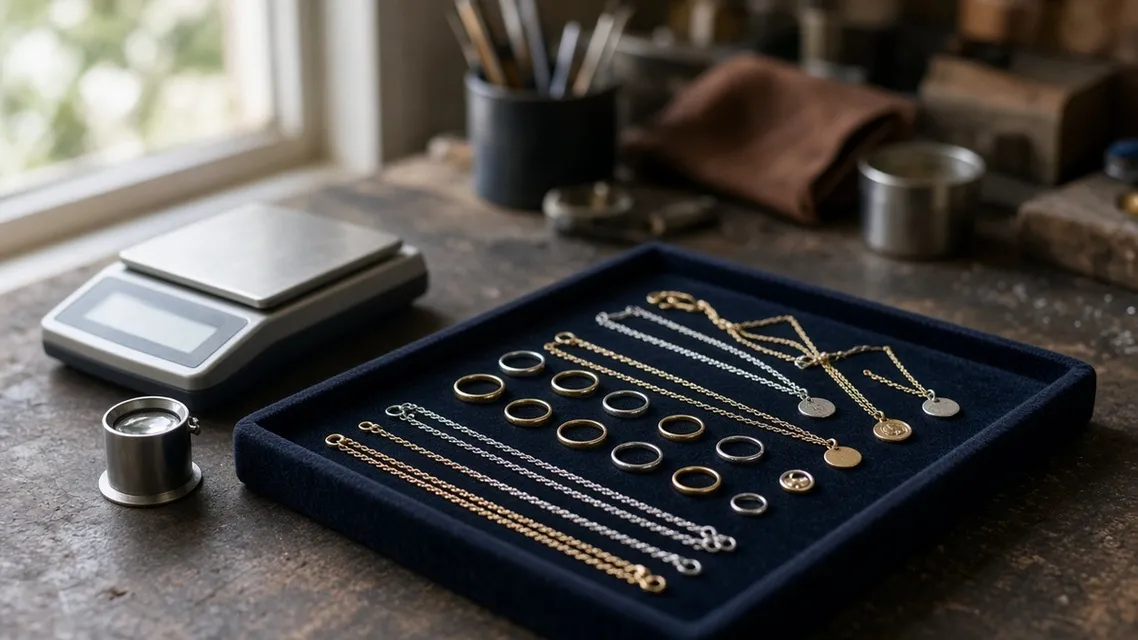
The quickest way to judge a supplier quote is to work out the metal content and compare it with what you are being charged. A troy ounce is 31.1035 grams. Gold jewellery is an alloy, so the karat tells you the share of pure gold: 9ct is 37.5%, 14ct is 58.5% and 18ct is 75%. Sterling silver is 92.5% silver. Multiply the spot price per gram by that share and by the weight of the piece.
| Metal (per gram of finished alloy) | At gold record (29 Jan 2026) | 30 June 2026 | 27 Nov 2026 | Change from record or June |
|---|---|---|---|---|
| 9ct gold (37.5%) | A$92.85 | A$70.06 | A$65.08 | Down 30% from record |
| 14ct gold (58.5%) | A$144.84 | A$109.29 | A$101.53 | Down 30% from record |
| 18ct gold (75%) | A$185.69 | A$140.12 | A$130.16 | Down 30% from record |
| Sterling silver (92.5%) | n/a | A$2.53 | A$1.91 | Down 24% from June |
Our calculation from the Perth Mint and World Gold Council prices above, metal value only. It excludes making charges, stones, plating, findings and margins.
On a 3 gram 9ct gold chain, the gold content was worth about A$279 at the January peak and about A$195 now, a difference of roughly A$84 per chain before any making charge or margin. A 6 gram 18ct ring has lost about A$333 of metal value since the record. A 10 gram sterling silver chain holds about A$19 of silver today against A$25 at the end of June. That is a smaller dollar amount, but on a piece wholesaling for A$40 to A$60 it is a meaningful share of the cost.
💡 Tip: Ask every supplier to break a quote into metal weight, karat or fineness, and making charge. If the metal line has not moved since mid-year, ask why. Suppliers who buy metal ahead may have a fair reason, but you should hear it.
Worked Example: Landed Cost of an Imported 9ct Gold Order
Imported jewellery attracts both customs duty and GST. The Australian Border Force states that gold, silver and platinum jewellery is not "precious metal" for GST purposes, because it is not in an investment form, and that consignments over A$1,000 are assessed for duty and GST. Under Chapter 71 of the Customs Tariff, the general duty rate for precious metal jewellery (tariff items 7113.11 and 7113.19) and for imitation jewellery (7117) is 5%. A free trade agreement rate may apply if the goods meet that agreement's rules of origin, so check the origin paperwork before you assume 5% or zero.
The example below is illustrative. It assumes 50 pieces of a 3 gram 9ct chain, a making charge of A$45 per piece, and A$150 of international freight and insurance. Duty is charged on the customs value. Import GST is charged at 10% on the value of the taxable importation, which is the customs value plus duty, freight and insurance. A GST-registered business can usually claim import GST back as a credit, so the landed cost below excludes it. Our importing guide explains each step in more detail.
| Line item (50 chains) | Priced at January record | Priced at 27 Nov 2026 |
|---|---|---|
| Gold content per chain (3 g of 9ct) | A$278.54 | A$195.24 |
| Supplier price per chain (metal plus A$45 making) | A$323.54 | A$240.24 |
| Customs value (50 chains) | A$16,177.09 | A$12,012.22 |
| Duty at 5% | A$808.85 | A$600.61 |
| Freight and insurance | A$150.00 | A$150.00 |
| Import GST at 10% (usually claimable) | A$1,713.59 | A$1,276.28 |
| Landed cost per chain, excluding GST | A$342.72 | A$255.26 |
Our calculation. The same order costs about A$87 less per chain to land, a 26% saving. The making charge and freight have not moved, so the saving as a percentage is smaller than the fall in gold. That gap widens on light, design-heavy pieces where labour is a bigger share of the price, which is why a 30% fall in gold does not mean a 30% cheaper catalogue.
💡 Tip: If you are paying in US dollars, watch the exchange rate too. A further fall in the Australian dollar would claw back part of the saving, so consider locking in a rate or paying a deposit when a quote suits you.
Is Demand Holding Up?
Worldwide, high prices have pushed buyers towards lighter and lower-carat pieces. The World Gold Council's Gold Demand Trends Q3 2026 report found global gold jewellery consumption fell 17% year on year in the September quarter to 313 tonnes, its weakest third quarter since its data began in 2000. Spending still rose 2% to US$43 billion because each gram cost more. US demand fell 18% to 21 tonnes, and the report noted that retailers in India were promoting diamond-set pieces in 18k, 14k and 9k gold to protect margins.
Australia has been steadier. The same report put Australian gold jewellery demand at 1.7 tonnes in the September quarter, down just 1% on a year earlier and up 73% on a weak June quarter. Australia used 2.3 tonnes in the December quarter of 2025, the Christmas period, so a seasonal lift is normal from here.
| Market | Q3 2025 (tonnes) | Q3 2026 (tonnes) | Change |
|---|---|---|---|
| World | 376.4 | 312.9 | Down 17% |
| United States | 25.6 | 21.0 | Down 18% |
| India | 125.0 | 99.9 | Down 20% |
| China (mainland) | 84.1 | 65.7 | Down 22% |
| Australia | 1.8 | 1.7 | Down 1% |
Source: World Gold Council, Gold Demand Trends Q3 2026 (data from Metals Focus). These figures cover gold jewellery only, not silver or costume pieces.
For a buyer, the message is that the price fall arrives just as Australian shoppers enter their busiest gift period, and after a year in which many people traded down to 9ct, smaller pieces and silver. Lower metal costs give you room to restore some of the weights and carats customers stopped seeing, without lifting shelf prices. Our Christmas 2026 stock planning guide covers order timing and courier cut-offs.
What Our Directory Data Shows About the Jewellery Supply Base
Not every jewellery supplier is equally exposed to metal prices. We grouped the 21 active listings in our Jewellery category on 27 November 2026 by what their own listing descriptions say they mainly sell. The grouping is our judgement from those descriptions, not a statement by the suppliers.
| Supplier group (by main product, from listing text) | Listings | Exposure to metal prices |
|---|---|---|
| Gold, silver and fine jewellery makers or metal merchants | 3 | High: quotes should track the gold price closely |
| Sterling silver and silver-led wholesalers | 4 | High on silver content, moderate overall |
| Gemstone, opal, pearl and diamond specialists | 4 | Low to moderate: stones drive the price |
| Fashion, pewter, findings, beads and piercing jewellery | 6 | Low: base metals and labour drive the price |
| Mixed gifts, sourcing agents and other | 4 | Varies |
| Total | 21 |
Source: Wholesale Directory Australia live listings, 27 November 2026. Seven of the 21 are directly tied to precious metal prices. Those are the suppliers to approach first for new quotes. For the rest, the gold price is a talking point rather than a reason to expect lower prices. Costume and fashion lines in Fashion Accessories depend more on freight, plating and labour.
Six Buying Decisions to Make Now
1. Re-quote open and repeat orders on metal-heavy lines
Any order quoted between February and October on solid gold or sterling silver is worth a fresh quote. Use the metal-per-gram table to show the supplier what has changed. Most wholesalers would rather adjust a price than lose a repeat customer, and our guide on how to negotiate with a wholesaler covers the approach.
2. Move to metal-linked pricing
Ask suppliers to quote metal at the day's price plus a fixed making charge per piece or per gram. You then gain when metal falls and share the risk when it rises, instead of paying a fixed price set at the peak. Agree in writing which reference price is used and on which day the order is priced.
3. Do not panic-sell stock bought at the peak
Gold is back near September 2025 levels, not below them, and a December US rate rise is already priced in. A gradual markdown through the new year usually loses less than a quick clearance. If you do need to clear stock, our excess stock guide covers the options.
4. Keep discount claims honest
Lower costs make "sale" pricing tempting, especially around peak season. Be careful with was/now claims. In the ACCC case against Prouds Jewellers, the Federal Court found the jeweller's catalogue comparisons misleading because the items had not been offered at the "was" price for a reasonable period beforehand. Only show a "was" price you genuinely charged, and keep the records. Our peak season guide has more on promotions.
5. Know the GST rules before selling scrap or old stock
Some retailers sell damaged or slow stock to refiners for its metal value. According to the ATO, gold, silver or platinum that is not of investment fineness, such as jewellery alloys, is "valuable metal". Sales of valuable metal to a GST-registered business fall under a mandatory reverse charge, which means the buyer accounts for the GST. Check how your refiner handles it before you sell, and keep the paperwork.
6. Rebuild range depth, not just margin
Global data shows customers trading down to lighter, lower-carat pieces. With metal cheaper, consider adding back a heavier 9ct line or a 14ct option at the price points you already sell, rather than pocketing the whole saving. A wider range at familiar prices usually sells better than the same range at a slightly lower price.
Practical Tips for Jewellery Buyers
- Track one reference price. Pick a single source, such as the Perth Mint Australian dollar spot price, and record it on the day each order is quoted.
- Weigh samples. A jeweller's scale costs little and confirms the metal weight you are paying for.
- Ask for fineness marks and assay details on solid gold and silver lines, and keep them with the supplier file.
- Split orders. Ordering in two or three tranches spreads the risk of a sharp rebound or a further fall.
- Keep two suppliers per key line. Our guide to wholesaling jewellery in Australia explains how the local supply chain fits together.
Frequently Asked Questions
Will wholesale jewellery prices fall as much as gold?
No. Metal is only part of the price. Making charges, stones, freight and margins have not fallen, so finished pieces usually fall by less than the metal. In our worked example, a 30% fall in gold cut the landed cost of a 9ct chain by 26%.
Is imported gold jewellery GST-free like bullion?
No. The ABF and ATO treat jewellery as a taxable supply because it is not precious metal in an investment form. Imported jewellery is assessed for duty and GST when a consignment is worth more than A$1,000.
Should I wait for prices to fall further before ordering for Christmas?
For Christmas stock, timing and availability matter more than a few more percent off the metal price. Order core lines now, consider metal-linked pricing for later orders, and keep Valentine's Day and Mother's Day buying flexible.
Are you a jewellery wholesaler or maker? List your business on Wholesale Directory Australia so retailers looking for new quotes can find you.
Last updated: 27 November 2026. Gold and silver prices are from the Perth Mint (live, month-end and end of financial year prices) and the World Gold Council. Market reports are from Reuters (20 November 2026) and CNBC (25 November 2026). Exchange rates are from the Reserve Bank of Australia. Duty and GST rules are from the Australian Border Force, the Customs Tariff and the ATO. Directory counts are from Wholesale Directory Australia's live listings. Prices change daily, so confirm current figures before you order.
📌 Related reading: Wholesale Jewellery Suppliers Australia · Wholesaling Jewellery in Australia · Importing Goods into Australia in 2026: Duty, GST and Landed Costs Explained · What Will Sell Out Before Christmas 2026? A Stock Planning Guide for Australian Retailers.Continue exploring: How to Sell Excess Stock in Australia: Clearance, Liquidation and Bulk Buyers Guide 2026 · How to Negotiate with a Wholesaler Effectively · Black Friday and Cyber Monday 2026: A Peak Season Guide for Australian Wholesalers and Retailers.