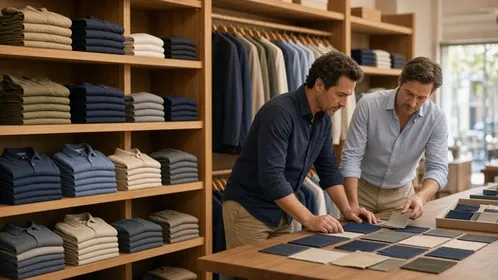
There was a time when fashion industry analysts scoffed at the idea of e-commerce within their market; this is when there were strong doubts about shoppers abandoning the established customs of going to department stores or boutiques, browsing the clothing racks, and trying out garments in the changing rooms. The prevailing wisdom at the time was that the apparel shopping experience could not be replicated on a digital medium. In 2023, we see the opposite of what those sceptic analysts believed: Not only have shoppers fully embraced e-commerce, they can't wait for the metaverse to become mainstream so that their avatars can enter virtual reality shops and try garments on.
The future of fashion retail will be dictated by internet technology. Shoppers have already voted with their smartphones and wallets in this regard, so it only makes sense for budding e-commerce entrepreneurs to look for opportunities in online clothing retail. According to the Interactive Advertising Bureau (IAB), 72% of Australian online shoppers made at least one clothing purchase online during the final months of the COVID-19 pandemic, and this percentage is noticeably higher when compared to other markets. Let's take a closer look at this sector, what it takes to get started with e-commerce these days, and how to strategize for success.
The Australian E-Commerce Landscape
In early 2023, Australia was ranked as the 11th largest market for e-commerce and online retail activity. According to estimates published by the Business Insider and Statista research groups, the e-commerce sector in the Commonwealth is growing at a rate of 15.5% on an annual basis, and this is significant when considering that the annual growth of the traditional brick-and-mortar sector is just 3.4%. By the year 2024, e-commerce in Australia will be a sector valued at more than $45 billion, and a sizable portion of this market will be driven by dropshipping transactions.
How Apparel Dropshipping Works
Of the $45 billion in Australian e-commerce revenues, 25% will be generated from fashion, apparel, and clothing sales. This translates into an $11 billion opportunity for prospective entrepreneurs who wish to get into the lucrative world of internet retail. Something that makes Australia such an enticing e-commerce market is how fast it is growing; according to the IAB, 80% of shoppers in Australia had already completed e-commerce purchases by 2018, and this is a trend that is quickly becoming a new paradigm, particularly among fashion and apparel shoppers.
Dropshipping is a business model that has been around since the early days of e-commerce. Way before the first shopping website launched in 1992, home shopping television channels and mail-order catalogue companies used dropshipping methods in which the retailer did not keep products in stock before selling them; instead, sellers established wholesale business relationships with manufacturers and distributors. As can be imagined, dropshipping has changed quite a bit in the last 30 years because it has progressed along with e-commerce, but the basic premise is the same.
Dropshipping works through vendors who are selling products online but only have control over orders, not stock levels. In this way, shoppers can make e-commerce purchases that are fulfilled by a wholesale third-party business entity. Dropshipping has become especially popular with retailers who don't have access to enough capital to build up large stockrooms; a dropshipping business allows entrepreneurs to get started quickly and with small outlays of capital, with profits coming in later.
It is estimated that 40% of global e-commerce is being carried out through dropshipping, and this figure is expected to grow as the new generation of Australian internet shoppers becomes more accustomed to the process. The most attractive aspect of this business model is the ability to run profitable e-commerce businesses with minimal investment because there are no inventory costs, and minimal operating costs to pay for a staff that works just to fulfil orders. Quite a few successful e-commerce entrepreneurs start out on their own, and they are able to operate their businesses for years without having to hire staff members.
Australian Wholesalers: The Key to Successful Dropshipping
The Australian market presents a few advantages for entrepreneurs who operate in the clothing segment. As mentioned above, Australian shoppers have shown a knack for going online when they feel like upgrading their wardrobe; this is a nice premise for organic growth, but there is also the insular nature of the market as well as its proximity to Asian textile hubs.
When it comes to selling and dropshipping apparel for the Australian market, you need to work with the right Australian wholesalers and suppliers. You always want to look for suppliers who can adapt to the evolving e-commerce landscape. There is no limit as to how many wholesalers you can work with, but you have to choose the ones that can align with your business plan.
Working with the right Australian clothing wholesaler can take your e-commerce venture far by cutting down on shipping times. When evaluating apparel suppliers, find the locations of their warehouses and how quickly they can ship parcels to your shoppers or to an intermediate address where you operate. Working with a domestic wholesaler also makes sense in terms of communications and business practises; this is often a problem with overseas suppliers because of language barriers and a lack of familiarity with Australian commerce.
As for profit margins, they can be quite handsome for dropshippers who establish good working relationships with their wholesaling partners, particularly in the clothing segment. As mentioned above, Australia enjoys proximity and trade with major Asian textile markets; this makes it possible to source products at lower prices. One thing to keep in mind is that the minimum order quantity (MOQ) of clothing wholesalers tends to be larger than what many newcomers expect, but many suppliers are getting flexible in this regard. Orders with larger quantities will always yield better discounts, but if this is not your business model, you will want to ensure that the wholesaler can ship lower quantities without issue and at a cost that still leaves room for a nice profit.
Although MOQs, shipping times, packaging, and client services are important factors in the dropshipping business, there is another dimension to consider. The fashion industry revolves around trends and styles; if the Australian clothing wholesalers you work with do not update their catalogue according to what's in style, your dropshipping business will fall behind the curve and lose its competitive edge. For this reason, it is crucial to have more than one supplier in your contact list; moreover, you should also be on the lookout for prospective new partners.
📌 Quick link: Clothing & Apparel · Fashion Accessories.
📌 Related reading: Wholesale Clothing Suppliers Australia · How to Start a Reselling Business in Australia: Complete Guide 2026 | Wholesale Directory · Importing Goods into Australia in 2026: Duty, GST and Landed Costs Explained · Product Safety Laws in Australia 2026: A Compliance Guide for Wholesalers, Importers and Retailers.Continue exploring: How to Find Wholesale Suppliers in Australia: The Complete Guide for 2026 · How to Negotiate with a Wholesaler Effectively.